Sunday, August 16, 2026
Why Do Good People Suffer?
 |
| Job suffered but didn't lose faith in his Redeemer. Image created by ChatGPT. |
Job, Jesus Christ, the Book of Mormon, and the Doctrine and Covenants
When Job 1–2, Job 19, Job 38–42, John 9, Mosiah 24, and Doctrine and Covenants 121–122 are read together, a remarkably consistent picture emerges. The scriptures do not give one simple explanation for all suffering. Instead, they challenge the assumption that suffering proves wickedness and teach that adversity can become a setting for faith, revelation, spiritual growth, and ultimately redemption through Jesus Christ.
|
Scripture |
The suffering |
What it teaches |
|---|---|---|
|
Job 1–2 |
Job loses his possessions, children, health, and security despite being described as righteous. |
Righteousness does not protect a person from every tragedy. Suffering is not necessarily punishment for sin. |
|
Job 19 |
Job feels abandoned by friends and even by God. |
Faith can coexist with grief and unanswered questions. Job nevertheless declares hope in his living Redeemer. |
|
Job 38–42 |
God finally answers Job, but does not give him a simple explanation for his suffering. |
God’s knowledge and purposes exceed human understanding. Faith sometimes requires trusting God without knowing why. |
|
John 9:1–3 |
A man has been blind from birth. The disciples assume someone’s sin must explain it. |
Jesus explicitly rejects the idea that suffering necessarily results from personal sin. God’s works can be manifested through human adversity. |
|
Mosiah 24:8–16 |
Alma’s righteous people are enslaved and persecuted. |
God does not immediately remove their burdens. He first strengthens them so they can bear them; eventually He delivers them. |
|
D&C 121 |
Joseph Smith suffers in Liberty Jail and asks, “O God, where art thou?” |
God permits honest questioning. Adversity can be temporary in an eternal perspective. Joseph is explicitly compared with Job. |
|
D&C 122 |
The Lord describes increasingly terrible possibilities Joseph might experience. |
Adversity can “give thee experience” and ultimately work for one’s good. Christ has descended below all suffering. |
1. Good people sometimes suffer precisely when they have done nothing to deserve it
This is perhaps the clearest lesson obtained by reading these passages together.
Job 1:1 deliberately establishes Job’s character before describing his catastrophes. He is “perfect and upright,” fears God, and avoids evil.
Yet almost everything is taken from him.
That fact is essential to the book’s theology. Job’s friends continually try to make suffering fit a simple formula:
Righteousness → blessings
Sin → suffering
Job’s experience demonstrates that mortal life is more complicated.
Jesus makes essentially the same correction in John 9. Seeing a man blind from birth, the disciples ask:
“Who did sin, this man, or his parents?”
Jesus answers:
“Neither hath this man sinned, nor his parents.”
Christ therefore explicitly rejects the disciples’ attempt to identify someone’s moral guilt from his physical suffering.
Collective lesson: We should be extremely cautious about interpreting another person’s tragedy as evidence of God’s displeasure.
2. Sometimes God does not tell us why
This may be one of the most profound aspects of Job.
Job repeatedly wants an explanation. When God finally speaks in Job 38–41, He gives Job something different.
Rather than explaining the chain of events in chapters 1–2, God reveals something about Himself.
He asks Job questions about creation, nature, life, and the universe—matters vastly beyond Job’s control or comprehension.
The message is not simply, “You aren’t intelligent enough to understand.”
It is closer to:
You cannot see everything I see.
That changes Job’s perspective. In Job 42:3, Job acknowledges that he had spoken about things “too wonderful” for him to understand.
This is important because scripture does not promise that faithful people will receive a satisfactory explanation for every tragedy during mortality.
Sometimes the answer to “Why?” becomes “Do you trust Me even when you cannot see what I see?”
3. Faith does not require pretending that suffering doesn’t hurt
Job cries out. He mourns. He questions. He wishes he had never been born.
Joseph Smith does something remarkably similar from Liberty Jail:
“O God, where art thou?”
— D&C 121:1
That is significant.
The Lord does not condemn Joseph for asking the question.
Instead He answers:
“My son, peace be unto thy soul…”
The scriptures therefore distinguish questioning God in anguish from abandoning God.
A faithful person can simultaneously say:
“I believe in God”
and
“I don’t understand why God is allowing this.”
Job and Joseph Smith both demonstrate that those statements can coexist.
4. God may strengthen us before He removes the burden
Mosiah 24 adds an especially important Restoration perspective.
Alma’s people pray for deliverance from oppression. God hears them—but He doesn’t immediately eliminate the problem.
Instead:
“I will also ease the burdens which are put upon your shoulders…”
Then comes the remarkable description:
“The Lord did strengthen them that they could bear up their burdens with ease.”
Only afterward does God deliver them.
There is a progression:
Burden → Prayer → Strength → Endurance → Deliverance
We often pray for God to change the circumstance.
Mosiah 24 teaches that sometimes His first miracle is to change our capacity to endure the circumstance.
5. Suffering can become experience rather than merely loss
The Doctrine and Covenants takes the principle another step.
The Lord tells Joseph:
“Know thou, my son, that all these things shall give thee experience, and shall be for thy good.”
— D&C 122:7
Notice that the Lord does not call terrible things good.
Rather, He says they can be for thy good.
That distinction matters.
The scriptures do not require us to call disease, death, persecution, betrayal, or tragedy good. They teach that God can take experiences that are genuinely painful and bring something redemptive from them.
This is very different from saying, “Everything happens because God wanted it to happen.”
These passages do not support such a simple conclusion.
They support the stronger and more nuanced proposition:
Whatever happens, God can work through it.
6. Job’s great answer ultimately points toward a Redeemer
In the middle of Job’s misery comes one of the Old Testament’s great declarations of hope:
“For I know that my redeemer liveth…”
— Job 19:25
Job’s circumstances have not yet changed.
His health isn’t restored. His losses haven’t been reversed. His questions haven’t been answered.
Yet he places his ultimate hope in a living Redeemer.
That becomes especially meaningful when read alongside the New Testament and Restoration scripture.
7. Jesus Christ changes the question
Doctrine and Covenants 122 reaches its theological climax with Christ:
“The Son of Man hath descended below them all. Art thou greater than he?”
— D&C 122:8
This may be the most important answer of all.
Christianity does not present a God who merely watches human beings suffer from a distance.
God entered mortality and suffered Himself.
Jesus experienced rejection, betrayal, loneliness, injustice, physical agony, grief, temptation, and death.
Thus the Christian response to Job is ultimately not merely a philosophical explanation of suffering.
It is Jesus Christ.
Job says:
“I know that my redeemer liveth.”
The Doctrine and Covenants declares that this Redeemer has “descended below them all.”
So why do good people suffer?
Taken together, these scriptures suggest several answers:
- Not all suffering is punishment for sin. Job and John 9 make this particularly clear.
- Mortality includes genuine adversity, even for the righteous. Covenant faithfulness does not guarantee an adversity-free life.
- We do not always know God’s purposes. Job never receives the kind of detailed causal explanation he initially seeks.
- God can manifest His works through suffering. Jesus teaches this in John 9.
- God sometimes strengthens us rather than immediately removing our burdens. Mosiah 24 illustrates this beautifully.
- Adversity can produce experience and spiritual growth. D&C 122:7 explicitly teaches this.
- It is permissible to grieve and ask God difficult questions. Both Job and Joseph Smith do so.
- Deliverance may not come immediately. Job, Alma’s people, and Joseph all endure before circumstances change.
- Our perspective is incomplete. Job 38–42 emphasizes the enormous difference between God’s knowledge and ours.
- The ultimate Christian answer to suffering is Christ. He does not merely explain suffering; He enters it, descends beneath it, and ultimately overcomes it.
A particularly powerful progression
Read sequentially, I think these passages form an unusually meaningful Restoration scripture study:
Job 1–2:
Why is this happening to a good person?
↓
Job 19:
Even though I don’t understand, “I know that my redeemer liveth.”
↓
Job 38–42:
God sees realities that I cannot see.
↓
John 9:
Do not assume suffering means someone has sinned.
↓
Mosiah 24:
Sometimes God strengthens us before He delivers us.
↓
D&C 121:
“O God, where art thou?” — It is permissible to ask.
↓
D&C 122:
“All these things shall give thee experience.”
↓
Jesus Christ:
“The Son of Man hath descended below them all.”
The central message
Taken together, I would summarize their teaching this way:
Good people do not suffer simply because they are good or bad. Mortality includes suffering whose purposes we may not presently understand. God does not promise that the faithful will avoid adversity, but He promises His presence, strength, perspective, and eventual redemption. We may not receive an answer to every “Why?” in this life, but Christianity gives an answer to “Who is with me in it?”—Jesus Christ, who descended below all things and lives as our Redeemer.
That, in many ways, is the Restoration’s answer to the question Job began asking thousands of years ago.
Labels: Adversity, endurance, faith, redemption, Suffering


Sunday, August 09, 2026
Finding strength in Jesus
I Glory in My Jesus

In his April 2026 general conference message, “I Glory in My Jesus,” Elder Aaron T. Hall teaches that discipleship is not only about knowing who Jesus Christ is, but about coming to know Him personally.
Elder Hall draws on Nephi’s declaration:
“I glory in my Jesus.” —2 Nephi 33:6
The word “my” is significant. Nephi had experienced the Lord’s help, mercy, protection, and sustaining power. Because of those experiences, Jesus Christ was not distant or abstract to him. Nephi knew the Savior personally.
Elder Hall encourages us to develop that same relationship with Christ. One way to do this is to study the many names and titles of Jesus Christ and consider what each reveals about His mission and His role in our lives.
Key Teachings
Jesus Christ is our Redeemer.
Through His Atonement, we can repent, receive forgiveness, and change. Repentance is not simply about correcting mistakes; it is an invitation to return to Christ and become more like Him.
Jesus Christ is our Good Shepherd.
He guides, gathers, protects, and seeks after us. When we feel lost or uncertain, He continues to invite us to follow Him.
Jesus Christ is our Healer.
The Savior understands our physical, emotional, and spiritual pain. His healing may come immediately, gradually, or ultimately through the Resurrection, but His power to heal is certain.
Jesus Christ is our Advocate.
Because of His Atonement, Christ pleads our cause before the Father. We depend upon His grace and mercy rather than relying solely upon our own efforts.
Jesus Christ is our Lawgiver.
His commandments are not merely restrictions. They provide direction, protection, and a path that leads us back to God.
Jesus Christ is our Deliverer.
He can deliver us from sin, fear, temptation, sorrow, and ultimately from death. Sometimes He removes our trials; at other times, He gives us strength to endure them.
Names of Jesus Christ Highlighted in the Message
Jesus, Jesus Christ, Son of God, Messiah, Redeemer, Savior, King of Kings, Prince of Peace, Good Shepherd, Healer, Advocate, Lawgiver, Deliverer, Master, Counselor, Friend, the Living Christ, and the Resurrected Christ.
Each name teaches us something about who Christ is and how He ministers to us.
A Question for Personal Study
Elder Hall’s message invites us to move from saying:
“Jesus Christ is the Savior”
to being able to say:
“Jesus Christ is my Savior.”
As we recognize His influence in our lives, our testimony becomes increasingly personal.
Consider asking:
Which name of Jesus Christ describes how I most need Him in my life today?
When we experience His mercy, direction, healing, forgiveness, and sustaining power, we can come to understand Nephi’s simple but powerful declaration:
“I glory in my Jesus.”
Reference
Hall, A. T. (2026, April). I glory in my Jesus. General Conference, The Church of Jesus Christ of Latter-day Saints. https://www.churchofjesuschrist.org/study/general-conference/2026/04/53hall?lang=eng
I can also turn this into a clean one-page printable PDF handout if you want.
Labels: covenants, discipleship, faith, Jesus Christ, redemption
Sunday, June 14, 2026
Finding Your Way Back:
Helping Others Discover the Path Home to Jesus Christ
 |
| To those who are struggling to come home, know that it is your Savior who's the one calling you back. |
This powerful address given by Elder Clark G. Gilbert during the April 2026 General Conference serves as a beautiful, encouraging reminder of the Savior's infinite mercy and the reality of redemption.
By John Fisher (assisted by AI)
Why This Article Has Deep Meaning
This address resonates because it tackles the silent, heavy vulnerabilities so many of us carry. It speaks directly to the modern anxieties of feeling like an outsider, wrestling with private doubts, or feeling fundamentally "not good enough" for God.
By framing Jesus Christ not just as a distant judge, but as a tender Redeemer and Repairer, the message shifts our focus away from our own shortcomings and redirects it toward His grace. It reminds us that the Church isn't a showcase for the perfect, but a refuge for the weary.
What You Can Learn
Perfection is Not a Prerequisite: You do not need to have your entire life or testimony flawlessly sorted out to show up. Christ asks for your best and promises to bridge the gap.
Anchor in Your Known Truths: When hit with doubts or complex questions, you don't have to resolve every single issue instantly. Instead, anchor yourself securely in what you *do* know and feel, and allow the Holy Ghost to guide you through the rest.
How to Best Help Loved Ones: When trying to guide a friend or family member back to the faith, the answer isn't to compromise your standards or "chase" them into the dark. The most powerful thing you can do is joyfully live your own covenants and keep your light shining bright.
Key Points Summary
1. The Savior as the Ultimate Repairer: While choices have real consequences and missteps can bind our future, the gospel provides a way out. Christ specializes in repairing the broken areas of our lives.
2. Overcoming the Four Barriers to Coming Home: Elder Gilbert uses real-life ministering stories to address the four common hurdles that keep people from returning:
- Feeling you don't belong (the fear of walking back through the chapel doors).
- Feeling you don't measure up (the false belief that everyone else is perfect).
- Wrestling with doubts (getting stuck on triggering or secondary faith questions).
- Being trapped by traditions (cultural or familial expectations that conflict with truth).
3. The Illusion of Secular Happiness: Pulling away from faith does not silence life’s deepest questions. Seeking fulfillment outside of Christ’s gospel is ultimately more exhausting than the journey of discipleship.
4. The "Saved a Seat" Principle: True discipleship means actively creating an environment of belonging. Like the students who turned on their phone flashlights in a crowded arena to guide latecomers, we must signal to others that there is a place saved specifically for them.
5 Highlighted Quotes from the Talk
1. On Grace and Imperfection:
"Brother Vargas, you don’t have to be perfect to be in this Church. You just have to do your best, and Christ will make up the difference."
2. On the Futility of Searching Outside the Gospel:
"As President Nelson taught, 'The truth is that it is much more exhausting to seek happiness where you can never find it!'"
3. On Handling Doubts and Questions:
"We promised them that as they anchored in the things they did believe, the Lord would help with the things they didn’t.
4. On How to Help Those Who Have Strayed:
"To those who are trying to help those they love, hold on to the truth. Keep your covenants. Helping others requires you to stay in your covenants."
5. On Christ's Personal Invitation:
"To those who are struggling to come home, know that it is your Savior who's the one calling you back. In the end, everyone must make their own choices to come home."
Reference:
Gilbert, Clark G. "Come Home." General Conference, April 2026.
Labels: belonging, covenants, Grace, redemption, Testimony
Sunday, January 04, 2026
Old Testament Testifies of Christ
How symbols, types, and prophetic narratives in ancient scripture testify of Jesus Christ and invite us to center our faith and daily discipleship on Him
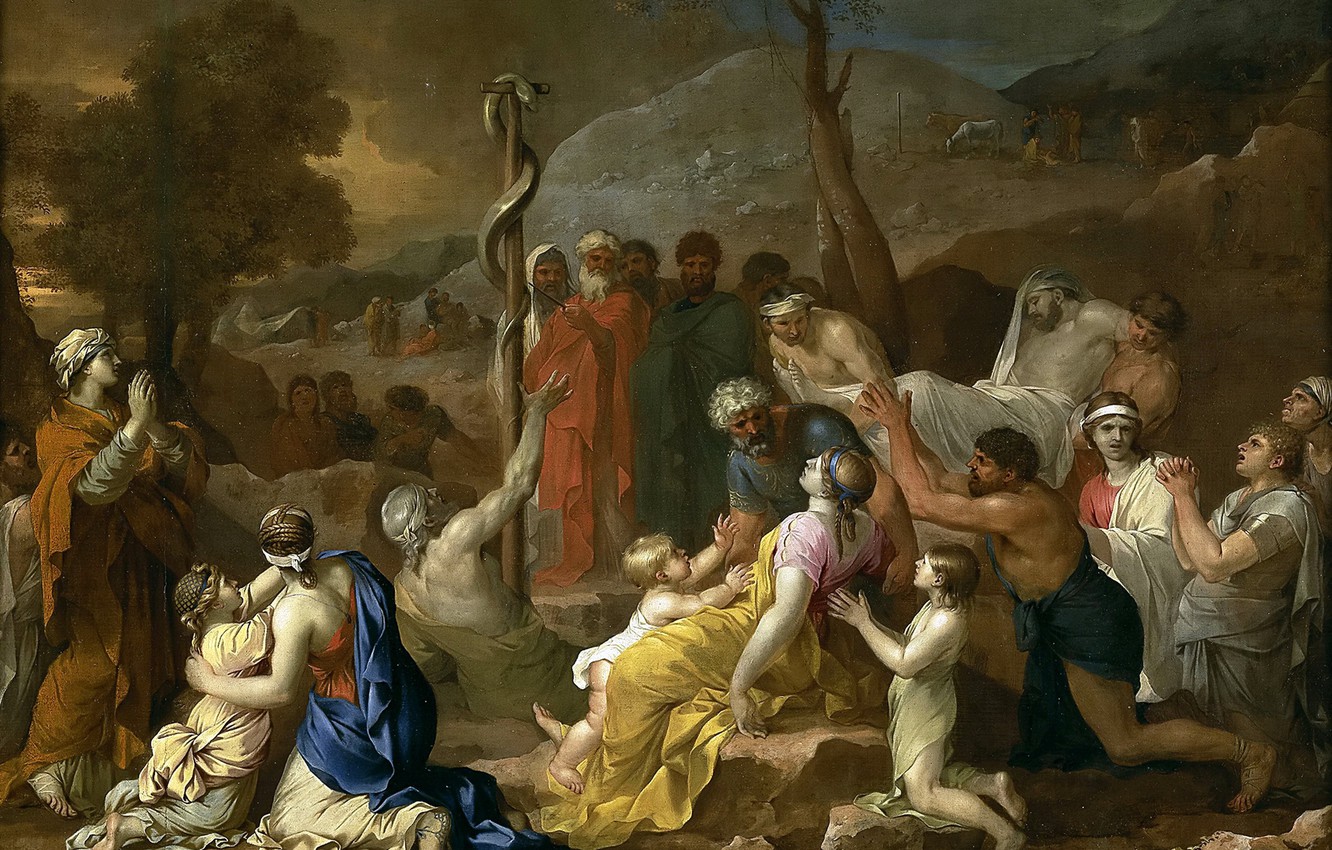 |
| Moses and the Brazen Serpent - Sebastien Bourbon c. 1653-4 |
By John Fisher (assisted by AI)
From its opening chapters to its prophetic promises, the Old Testament consistently bears witness of Jesus Christ. While His mortal ministry is recorded in the New Testament, the foundation of His mission, identity, and redeeming power is woven throughout the earlier scriptures. As the Savior Himself declared, “Search the scriptures; for in them ye think ye have eternal life: and they are they which testify of me” (John 5:39). One fruitful way to find spiritual nourishment in the Old Testament is to look for symbols, types, and narratives that point to Christ—the true Bread of Life (John 6:48). These accounts not only prepare the way for His coming but also deepen our understanding of who He is and what He offers to all who follow Him.
Types and Symbols of Jesus Christ in the Old Testament
Manna: The Bread of Life
When the children of Israel wandered in the wilderness, the Lord provided manna from heaven to sustain them daily. The Lord declared, “Behold, I will rain bread from heaven for you” (Exodus 16:4). Each morning the people gathered this miraculous food, described as “a small round thing…like coriander seed” (Exodus 16:14–15), sufficient for their immediate needs.
Jesus later revealed the deeper meaning of this provision: “I am the bread of life: he that cometh to me shall never hunger” (John 6:35). Just as manna sustained Israel physically, Christ sustains us spiritually. The daily gathering of manna teaches dependence upon God and reminds us that enduring spiritual life comes only through continual reliance on the Savior.
The Sacrificial Lamb
At the time of the Passover, Israel was commanded to select “a lamb without blemish” (Exodus 12:5) and to apply its blood as a sign of deliverance. This act preserved them from death and marked their liberation from bondage.
John the Baptist later identified Jesus as the fulfillment of this symbol: “Behold the Lamb of God, which taketh away the sin of the world” (John 1:29). The Passover lamb prefigures Christ’s perfect, sinless sacrifice. Through His atoning blood, all who follow Him are delivered from spiritual death and freed from the bondage of sin.
The Brass Serpent
When Israel murmured in the wilderness, fiery serpents afflicted the people. The Lord instructed Moses to raise a brass serpent so that “every one that is bitten, when he looketh upon it, shall live” (Numbers 21:8). Healing came not through human effort, but through faithful obedience and trust in God’s appointed means.
Jesus explained the symbolism plainly: “As Moses lifted up the serpent in the wilderness, even so must the Son of man be lifted up” (John 3:14). This account teaches that salvation comes by looking to Christ with faith. His crucifixion, like the raised serpent, offers healing and life to all who turn to Him.
Jonah: Death and Resurrection
Jonah’s experience in the depths of the sea—spending “three days and three nights in the whale’s belly” (Jonah 1:17)—became a powerful sign of Christ’s future resurrection. Jesus Himself declared, “As Jonas was three days and three nights in the whale’s belly; so shall the Son of man be three days and three nights in the heart of the earth” (Matthew 12:40).
Jonah’s deliverance foreshadows Christ’s triumph over death. This parallel testifies that Jesus is the promised Redeemer who would conquer the grave and offer resurrection to all mankind.
What These Examples Teach about Jesus Christ
Together, these Old Testament witnesses teach that Jesus Christ is our sustainer, redeemer, healer, and conqueror of death. They show that God’s plan of salvation was established from the beginning and consistently revealed through inspired symbols and prophetic events. Beyond these examples, many readers are familiar with additional references—such as the messianic prophecies of Isaiah, the promised Seed of Abraham, and the righteous King foretold by the prophets—all pointing forward to Christ.
Living the Invitation to Seek Christ
In his message “Jesus Christ Is the Treasure,” Elder Dale G. Renlund encouraged us to “remember and always focus on Jesus Christ.” Studying the Old Testament with this purpose in mind transforms scripture reading from a historical exercise into a deeply personal act of discipleship. As we seek Christ in ancient texts, we become more attuned to recognizing His hand in our own lives—guiding, sustaining, and redeeming us today.
Conclusion
The Old Testament is far more than a record of ancient Israel; it is a powerful testimony of Jesus Christ. Through symbols such as manna, the sacrificial lamb, the brass serpent, and the experience of Jonah, the scriptures consistently point to the Savior’s mission and divine identity. As we study with intent to find Him, we are nourished spiritually and drawn closer to the living Christ. By remembering and focusing on Him—in scripture and in daily life—we discover that He truly is the greatest treasure.
Reference
Renlund, D. G. (2023, November). Jesus Christ is the treasure. Liahona. https://www.churchofjesuschrist.org/study/liahona/2023/11/57renlund?lang=eng
Labels: Jesus Christ, Old Testament symbolism, redemption, scripture study, types of Christ
Monday, October 18, 2010
God loves his children in all times

In teaching his son Corianton, Alma addressed some of his concerns about the coming of Jesus Christ. Alma told Corianton that he shouldn't be surprised that God would tell before hand that his Son would come to the earth. After all, Jesus would redeem all his children.
Verse 17 Behold, you marvel why these things should be known so long beforehand. Behold, I say unto you, is not a soul at this time as precious unto God as a soul will be at the time of his coming?
18 Is it not as necessary that the plan of redemption should be made known unto this people as well as unto their children?
19 Is it not as easy at this time for the Lord to send his angel to declare these glad tidings unto us as unto our children, or as after the time of his coming?
We face a similar situation today. People say that we do not need prophets to teach us about Jesus Christ. We have all we need in the Bible. Yet, God loves his children today like in old times. We also are blessed because of the Savior's atonement. Jesus died for us like he died for people of olden times. So would God not be as concerned about his children today as in times past? Would he not reveal his secrets as he did in the past to his servants, the prophets? See Amos 3:7.
God has called living prophets, beginning with Joseph Smith. Through Joseph Smith, God restored the gospel of Jesus Christ and the priesthood authority that allows us to take upon us the name of Christ, repent of our sins, and be redeemed by Christ as were people that lived in his day and that of the ancient apostles.
Labels: Alma, atonement, Corianton, Jesus Christ, Joseph Smith. God's love, prophets, redemption, salvation

Subscribe to Posts [Atom]