Sunday, September 13, 2026
Walk Toward the Light
 |
|
When life seems darkest, continue walking toward the light. The empty tomb reminds us that because Jesus Christ lives, darkness does not have the final word. Image created by ChatGPT. |
Encounter at the Empty Tomb: Finding Jesus Christ in Times of Faith, Uncertainty, and Discipleship
Introduction
In his April 2026 general conference address, “Encounter at the Empty Tomb,” President Dieter F. Uchtdorf reflects on the women who approached the tomb of Jesus Christ early on the morning of the Resurrection. They came carrying grief, uncertainty, and unanswered questions. They were not expecting a miracle. They simply continued forward because of their love for the Savior.
What they discovered changed not only their lives but the course of human history: the tomb was empty. Jesus Christ had risen.
President Uchtdorf uses their experience to invite each of us to have our own encounter with the meaning of the empty tomb. We were not there on that Easter morning, but we can come to know through faith and personal spiritual experience that Jesus Christ lives. That knowledge should then influence how we live, serve, make choices, and treat others.
Summary
President Uchtdorf begins with Mary and the other women making their way to Christ’s tomb while it was still dark. They were grieving and undoubtedly had questions about how the Savior, who had healed the sick, raised the dead, and performed miracles, could Himself have died. Yet they continued toward Him. They did not have complete understanding; they simply acted because they loved Him.
At the tomb, they discovered that the stone had been rolled away and heard the extraordinary declaration that Jesus Christ had risen. President Uchtdorf emphasizes that this means Christ should not be viewed merely as a historical figure. Jesus Christ lives now. He continues to guide, comfort, strengthen, and bless those who follow Him.
The women at the tomb were given two responsibilities: first, to see and understand what had happened, and second, to go and tell others. President Uchtdorf applies these same responsibilities to modern disciples. We should seek our own testimony of the Savior and then become witnesses of Him through both our words and our actions.
One of the most meaningful parts of the message concerns unanswered questions. President Uchtdorf acknowledges that people may struggle with questions about life circumstances, the gospel, or the Church. He does not suggest that faith requires having every answer. Instead, he points to Mary and the other women: when everything seemed dark, they continued walking toward Christ. Understanding often comes after we begin moving forward in faith.
Ultimately, the empty tomb becomes a symbol of hope. Because Christ overcame death, no darkness, sorrow, uncertainty, or difficulty needs to have the final word. The invitation is to become joyful and consistent disciples who allow belief in the risen Christ to change how we live each day.
Five Memorable Quotes
- “When the world is dark, the best place to go is toward ‘the light [that] shines in … darkness.’”
- “Even when things seem dark, we step forward in faith, with courage and humility, and walk toward the Savior’s light.”
- “Like the warmth and light of the morning sun, we will feel the love and healing of the Son of God.”
- “Darkness will give way to eternal light.”
- “Jesus Christ is the light that leads us through this life, through any valley of sorrow, over beautiful mountains of joy, and across any ocean of uncertainty or temptation.”
How This Applies to Me
The part of this message that speaks most strongly to me is the example of the women walking toward the tomb before they knew what they would find. They did not understand everything. Their questions had not been answered. They were grieving and uncertain, yet they continued moving toward Christ.
That is an important reminder for me. I sometimes want understanding before action: I want to know how something will work out, why something happened, or what the eventual answer will be. This message reminds me that faith often reverses that order. Sometimes I must move forward first and allow understanding to come later.
It also makes me think about the experiences I have already had. President Uchtdorf asks, in essence, what have I personally seen, felt, or experienced? My testimony does not have to depend entirely on someone else’s experiences. I can look back on moments when I have felt peace, received guidance, experienced unexpected strength, or recognized God’s influence in my life. Those experiences become my own witnesses.
Another lesson concerns how I share what I believe. President Uchtdorf emphasizes that discipleship is not demonstrated only through words. Consistent acts of kindness, service, courage, patience, and love may communicate faith more powerfully than anything I say.
Finally, the empty tomb reminds me to approach difficulties with hope. Problems can be real without being permanent. Questions can remain unanswered without destroying faith. Darkness can surround me without becoming my destination. The women went to the tomb while it was still dark—but morning was already coming.
Perhaps that is the message I most want to remember:
Keep walking toward the light, even when I cannot yet see the sunrise.
Reference: Uchtdorf, D. F. (2026, April). Encounter at the empty tomb. The Church of Jesus Christ of Latter-day Saints. https://www.churchofjesuschrist.org/study/general-conference/2026/04/41uchtdorf?lang=eng
Labels: discipleship, faith, hope, Jesus Christ, Resurrection


Monday, August 24, 2026
Christ Knows Us By Name
 |
| Image created by Gemini |
“He Knows You by Name”
Elder Clement M. Matswagothata, April 2026 General Conference
Summary
Elder Matswagothata teaches that Jesus Christ knows each person individually. He knows our names, joys, sorrows, burdens, and unspoken prayers. The Savior’s Atonement enables Him not only to understand our suffering but also to strengthen and help us through it.
Elder Matswagothata explains that his surname means “getting out of a difficult situation” or “someone who can do hard things.” For him, this meaning symbolizes the Savior’s power to guide us through difficult seasons.
He recounts a time when grief, work pressures, family responsibilities, and Church service left him feeling overwhelmed. His reassurance came unexpectedly through a young boy who told him that his family prayed for him every morning and evening. Through this experience, Elder Matswagothata felt seen, loved, and remembered by the Savior.
The talk concludes by emphasizing that Christ will walk with us. The important question is whether we will deliberately walk with Him. Through faith, repentance, scripture study, covenants, and discipleship, we can receive His enabling power and find a way forward.
Central teaching
The Savior does not see us as anonymous members of a crowd. He knows and loves us individually. As we take His name upon ourselves through sacred covenants, His name becomes the most important part of our eternal identity.
Teaching points
- Jesus Christ knows us personally.
The Lord called Adam, Mary, Saul, Joseph Smith, and Moses by name. These examples show that God’s relationship with His children is personal. - The Savior understands every kind of suffering.
Because of His Atonement, Christ understands grief, illness, loneliness, anxiety, temptation, and silent pain. He knows how to succor—or personally assist—us. - Pain does not mean God has abandoned us.
Difficult circumstances are not evidence that God has stopped loving us. Trials may continue, but the Savior remains present. - God often answers prayers through other people.
The Primary child and his family became instruments through whom Elder Matswagothata felt the Savior’s love. - We should notice and lift those around us.
Just as God places people in our path to help us, He may place us in someone else’s path as an answer to prayer. - Covenants connect us with Christ’s power.
Through baptism, the sacrament, and temple covenants, we take Christ’s name upon ourselves and gain access to His enabling power. - Following Christ must be intentional.
Discipleship is more than occasional belief. It includes remembering Him, studying His words, repenting daily, and following Him consistently. - There is always a way forward through Christ.
The Savior not only shows us the way through hardship; He is the way.
Key quotations
- “He hears, sees, and knows you.”
- “To the Savior, we are never lost in the crowd.”
- “Your pain is not a sign that God does not love you.”
- “The real question is ‘Will I walk with Him?’”
- “May we become the kind of disciples who notice, reach out, and lift as the Savior did.”
- “In His time and in His way, there is always a way forward.”
- “He not only knows the way; He is the way.”
- “He desires to lead us home—one by one, by name.”
Lessons learned
- I can trust that Christ knows what I am experiencing, even when other people do not.
- I should not interpret unanswered prayers or continuing trials as evidence that God has forgotten me.
- An encouraging word, prayer, smile, hymn, or simple act of kindness may become God’s answer to another person.
- I should pay closer attention to people who may be carrying quiet burdens.
- Remembering Christ during the sacrament can strengthen my covenant identity and help me face difficult circumstances.
- Peace does not always come because a problem immediately disappears. It can come from knowing that the Savior walks beside me.
- Following Christ requires deliberate daily choices.
- My deepest identity comes from taking upon myself the name of Jesus Christ.
Discussion questions
- When have you felt that the Savior knew you personally?
- Who has God placed in your path during a difficult time?
- How can we become better at noticing people who carry quiet burdens?
- What does it mean in daily life to take the name of Jesus Christ upon ourselves?
- What could you do this week to walk with Christ more deliberately?
Read “He Knows You by Name” on ChurchofJesusChrist.org
Labels: covenant identity, discipleship, divine love, Jesus Christ, known by name
Sunday, August 09, 2026
Finding strength in Jesus
I Glory in My Jesus

In his April 2026 general conference message, “I Glory in My Jesus,” Elder Aaron T. Hall teaches that discipleship is not only about knowing who Jesus Christ is, but about coming to know Him personally.
Elder Hall draws on Nephi’s declaration:
“I glory in my Jesus.” —2 Nephi 33:6
The word “my” is significant. Nephi had experienced the Lord’s help, mercy, protection, and sustaining power. Because of those experiences, Jesus Christ was not distant or abstract to him. Nephi knew the Savior personally.
Elder Hall encourages us to develop that same relationship with Christ. One way to do this is to study the many names and titles of Jesus Christ and consider what each reveals about His mission and His role in our lives.
Key Teachings
Jesus Christ is our Redeemer.
Through His Atonement, we can repent, receive forgiveness, and change. Repentance is not simply about correcting mistakes; it is an invitation to return to Christ and become more like Him.
Jesus Christ is our Good Shepherd.
He guides, gathers, protects, and seeks after us. When we feel lost or uncertain, He continues to invite us to follow Him.
Jesus Christ is our Healer.
The Savior understands our physical, emotional, and spiritual pain. His healing may come immediately, gradually, or ultimately through the Resurrection, but His power to heal is certain.
Jesus Christ is our Advocate.
Because of His Atonement, Christ pleads our cause before the Father. We depend upon His grace and mercy rather than relying solely upon our own efforts.
Jesus Christ is our Lawgiver.
His commandments are not merely restrictions. They provide direction, protection, and a path that leads us back to God.
Jesus Christ is our Deliverer.
He can deliver us from sin, fear, temptation, sorrow, and ultimately from death. Sometimes He removes our trials; at other times, He gives us strength to endure them.
Names of Jesus Christ Highlighted in the Message
Jesus, Jesus Christ, Son of God, Messiah, Redeemer, Savior, King of Kings, Prince of Peace, Good Shepherd, Healer, Advocate, Lawgiver, Deliverer, Master, Counselor, Friend, the Living Christ, and the Resurrected Christ.
Each name teaches us something about who Christ is and how He ministers to us.
A Question for Personal Study
Elder Hall’s message invites us to move from saying:
“Jesus Christ is the Savior”
to being able to say:
“Jesus Christ is my Savior.”
As we recognize His influence in our lives, our testimony becomes increasingly personal.
Consider asking:
Which name of Jesus Christ describes how I most need Him in my life today?
When we experience His mercy, direction, healing, forgiveness, and sustaining power, we can come to understand Nephi’s simple but powerful declaration:
“I glory in my Jesus.”
Reference
Hall, A. T. (2026, April). I glory in my Jesus. General Conference, The Church of Jesus Christ of Latter-day Saints. https://www.churchofjesuschrist.org/study/general-conference/2026/04/53hall?lang=eng
I can also turn this into a clean one-page printable PDF handout if you want.
Labels: covenants, discipleship, faith, Jesus Christ, redemption
Tuesday, January 20, 2026
"No One Sits Alone!"
 |
| Elder and Sister Gong and friends in Pristina, Kosovo |
Choosing Christ Means Helping Others Feel Like They Belong
by John Fisher (assisted by AI)
In his October 2025 general conference address, Elder Gerrit W. Gong of the Council of Twelve Apostles delivered a simple, piercing message: no one should ever sit alone. In a world shaped by isolation, comparison, and quiet exclusion, his invitation was not merely to notice loneliness—but to act decisively to relieve it. The talk reframed belonging as a core expression of discipleship, grounded in the character of a loving God and lived out through ordinary, intentional choices.
For those of us worshipping in large wards of hundreds—and for Saints gathering in small branches such as Pristina, Kosovo—the message lands with equal force but different application. The scale may change; the responsibility does not.
Summary of the Message
Elder Gong taught that the gospel of Jesus Christ creates communities of inclusion rather than spectatorship. Belonging is not automatic; it is cultivated through seeing, welcoming, and staying with one another—especially those on the margins. The Savior’s ministry consistently crossed social, cultural, and emotional boundaries, and Elder Gong reminded us that covenant communities are healthiest when no one is overlooked, unseen, or left to worship alone.
This invitation is not a call to grand programs or new initiatives. It is a call to personal conversion. Discipleship is expressed in small but consequential acts: noticing who is missing, who is quiet, who arrives late, who leaves early, and who may be uncertain whether they truly belong. These everyday observations, followed by simple acts of care, are the building blocks of gospel culture.
Elder Gong described gospel culture not as a social style, demographic pattern, or set of unwritten expectations, but as a way of living that reflects the character of Jesus Christ. It is measured less by how efficiently meetings run and more by how people feel when they arrive, participate, and leave. In a true gospel culture, individuals are not valued for visibility, confidence, calling, age, or background. They are valued because they are known, seen, and loved.
At the center of this culture is intentional belonging. Gospel culture rejects exclusion by neglect, silence, or assumption. Instead, it is proactive, relational, and deeply personal. It requires disciples to notice others, make room for them, and remain with them—not as an obligation, but as an expression of love.
This culture also reflects a correct understanding of God. As Elder Gong taught through both word and example, we worship a loving Heavenly Father, not a distant or fear-based authority. That understanding shapes how we treat one another. When God is understood as loving, His Church becomes a place of refuge rather than performance. People are welcomed before they are evaluated, and belonging precedes growth.
Ultimately, gospel culture is not created by policies or programs alone. It is created through daily, quiet choices—who we sit with, who we speak to, who we follow up with, and who we refuse to let sit alone. Elder Gong’s message makes clear that gospel culture is lived one relationship at a time.
Five Short Quotes from the Address
-
“No one sits alone.”
-
“Belonging is a sacred responsibility.”
-
“The Savior notices those on the margins.”
-
“We reflect God’s love when we include.”
-
“Christ’s Church is a place of refuge, not fear.”
(Brief excerpts used for reflection; see full address for complete context.)
What This Looks Like in a Large Ward
In a ward of hundreds, loneliness can hide in plain sight. People can attend faithfully and still feel invisible. Elder Gong’s counsel invites deliberate, relational ministry rather than passive friendliness.
Concrete commitments may include:
-
Ministering with purpose. I can recommit to my assigned families—not as a checklist, but as relationships.
-
Ministering as a companionship. I can fully involve my ministering companion, who is a 14-year-old teacher, modeling that meaningful service is not age-dependent. Together, we can learn how to listen, show up, and follow through.
-
Seeing beyond circles. Sitting with someone new, introducing others across age or social lines, and noticing who might be standing alone in the hallway.
-
Following up. A text, a call, or an invitation after Sunday can make the difference between attendance and belonging.
Large wards require intentionality. When everyone assumes “someone else” will notice, people are left unseen. Elder Gong’s message places responsibility back where it belongs—on each of us.
What This Looks Like in a Small Branch
In a small branch like Pristina, the challenge is different but no less real. Numbers are few, but vulnerability can be high. Every absence is felt. Every new face matters.
In that setting, belonging looks like:
-
Shared responsibility. Everyone helps everyone—because there is no one else.
-
Deep relationships. Meals, conversations, and testimony meetings become intimate spaces of trust.
-
Cultural sensitivity. Inclusion requires understanding local histories, faith backgrounds, and lived experiences.
A friend who attended Elder Gong’s talk in Pristina shared a powerful observation afterward:
“The difference between the teachings of The Church of Jesus Christ of Latter-day Saints and other churches is that you teach of a loving God, whereas other churches teach you to fear God.”
That insight captures the heart of Elder Gong’s message. Where God is feared, people withdraw. Where God is loving, people gather—and make room for one another.
Questions to Ponder
-
Who in my ward or branch might be “sitting alone” in ways I have not noticed?
-
How can I move from friendliness to meaningful inclusion?
-
What does it look like to minister with someone—especially someone younger or less experienced?
-
How does my view of God shape how I treat others?
-
What simple action can I take this week to ensure no one sits alone?
Conclusion
“No One Sits Alone” is not merely a memorable phrase; it is a covenantal charge. Elder Gong reminded us that belonging is one of the clearest signals of Christ’s presence among His people. Whether in a crowded chapel or a small rented room in Pristina, the measure of our discipleship is found in who feels seen, welcomed, and loved.
I can do better. I can notice more. I can minister more intentionally—with my companion, with humility, and with consistency. When we choose inclusion, we do more than fill seats. We reflect the character of a loving God—and ensure that, truly, no one sits alone.
Reference
Gong, G. W. (2025, October). No one sits alone. General Conference of The Church of Jesus Christ of Latter-day Saints. https://www.churchofjesuschrist.org/study/general-conference/2025/10/25gong?lang=eng
Labels: belonging, community, discipleship, gospel culture, inclusion, ministering
Saturday, June 07, 2025
Teaching Children of Jesus
“Thou Art the Christ”:
Teaching Our Children to Believe, Belong, and Become
 |
| They brought their little children - by Walter Rane |
By John Fisher (assisted by AI)
Introduction:
In a world filled with distraction, doubt, and digital noise, Sister Amy A. Wright’s April 2025 General Conference message, “Thou Art the Christ,” reminds us that nothing matters more than teaching children to know, follow, and become like Jesus Christ. As First Counselor in the Primary General Presidency, Sister Wright offers powerful insights on how belief, belonging, and becoming form the foundation of lifelong discipleship—and how we can help children walk that path with purpose and joy.
Summary of the Talk:
Sister Wright begins with a touching story about her son Eli, whose passion for law—and for the Lawgiver, Jesus Christ—grew from a young age. His courageous testimony of Christ in a secular law school interview, and the unexpected outcome, set the stage for the talk’s central message: children must be taught to believe in Jesus, belong to His Church, and become like Him.
1. Believe – Children need more than just stories about Christ; they need to see, hear, and feel His presence in their daily lives. Testimonies, sacred images, and experiences with the Holy Ghost help children truly know Jesus Christ.
"I invite you to ponder what this can look like in the life of young children. Do they hear testimonies of Jesus Christ and His gospel? Do they see reverential, worshipful images of His ministry and godhood? Do they feel and recognize the Holy Ghost testifying of His reality and divinity? Do they know of His message and mission?"
2. Belong – Through covenantal belonging, such as baptism and Church membership, children are strengthened by sacred promises and community support. Parents and leaders play a vital role in preparing them for that path.
"How can we help children make and keep sacred covenants? In the Come, Follow Me manual, in appendix A and B, we find conversation starters and lessons that will empower families and support teachers and leaders in their sacred responsibility to prepare children for a lifetime on God’s covenant path."
3. Become – Children are not passive disciples. They are invited to act, to lead, to testify, and to grow into the likeness of Christ. We must guide them with love and give them opportunities to serve and shine.
"When we tell our children we love them, are we also telling them that their Father in Heaven and Savior Jesus Christ love them? Our love may comfort and inspire, but Their love can sanctify, exalt, and heal."
Five Inspiring Quotes from the Talk:
1. “The archetype of morality I strive to pattern my life from is that of Jesus Christ.”
2. “We want our children to believe in Jesus Christ, belong to Jesus Christ and His Church through covenant, and strive to become like Jesus Christ.”
3. “As Jesus Christ becomes the focus of our lives, what we desire, and how we desire it, is forever altered.”
4. “Without Jesus Christ there is no power to change, no purpose to aspire to, and no reconciliation of the travails of life.”
5. “This Jesus … [is] a glorified, omnipotent, resurrected, exalted, worshipful, powerful Only Begotten Son of God, who is mighty to save.”
Conclusion and Suggestions for Follow-up:
Sister Wright’s message is a clarion call to parents, teachers, and leaders: start now. Don’t wait to help children develop a relationship with Jesus Christ. Begin with small but meaningful actions:
• Share your personal testimony of the Savior regularly.
• Display reverent images of Jesus in your home.
• Read from the scriptures as a family, focusing on His words and works.
• Use the Come, Follow Me manual (Appendices A and B) to create simple, Christ-centered lessons.
• Give children meaningful roles in family home evenings, sacrament talks, and service opportunities.
Let us teach our children not only about Christ but to truly know Him. In doing so, we fulfill our divine responsibility and give them the greatest gift possible: the Light of the World.
Keywords:
Jesus Christ, children, discipleship, covenant, faith
Hashtags:
#ThouArtTheChrist #ComeFollowMe #FaithInJesus #PrimaryPurpose #ChristCenteredHome
Reference:
Wright, A. A. (2025, April). Thou Art the Christ. General Conference of The Church of Jesus Christ of Latter-day Saints. https://www.churchofjesuschrist.org/study/general-conference/2025/04/32wright?lang=eng
Labels: children, covenant, discipleship, faith, Jesus Christ
Saturday, December 07, 2024
Second Coming
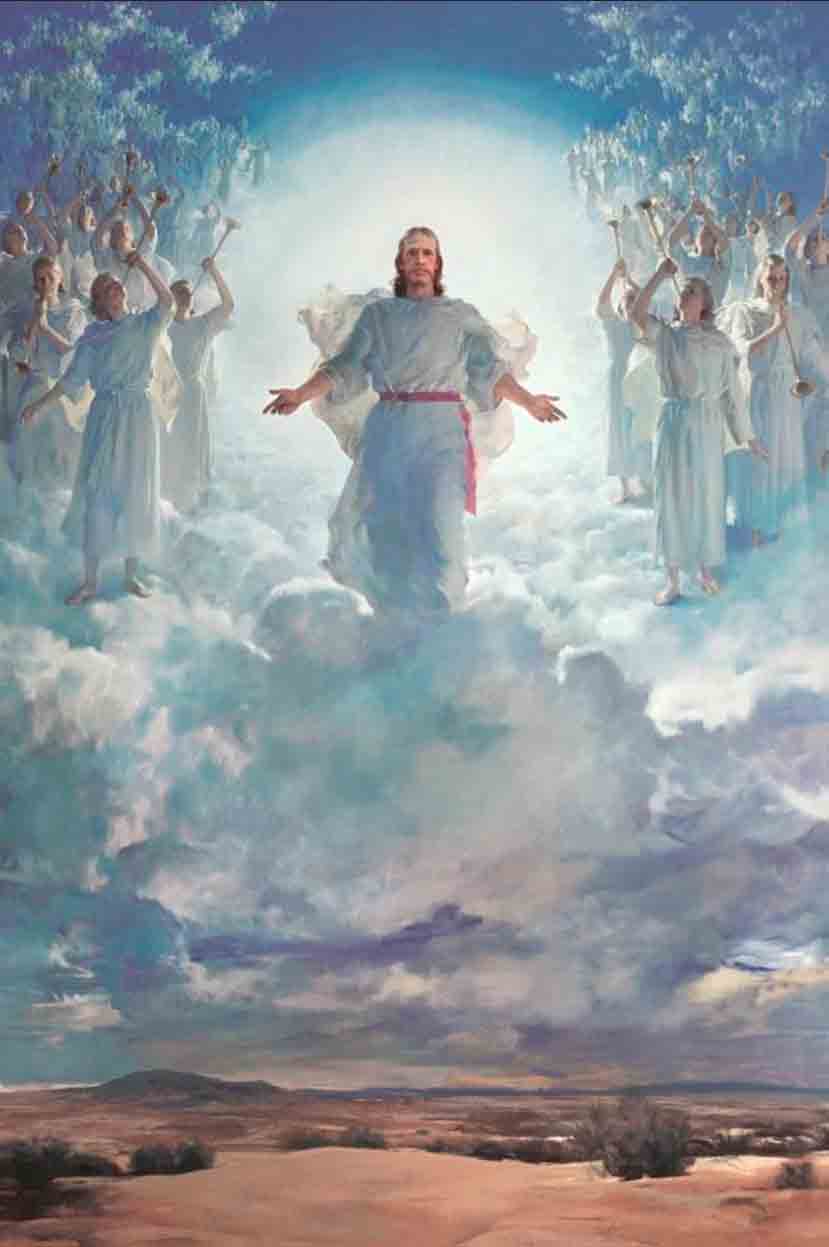 |
| The Second Coming by Harry Anderson |
Preparing the World for the Savior's Return
by John Fisher
In his October 2024 General Conference address, "The Lord Jesus Christ Will Come Again," President Russell M. Nelson emphasizes the urgency of preparing for the Savior's Second Coming. He highlights the accelerated construction of temples worldwide as a divine directive to gather Israel on both sides of the veil and to ready the world for the Lord's return. President Nelson calls upon individuals to prioritize their discipleship, engage in regular temple worship, and deepen their understanding of Jesus Christ's Atonement. He assures that sincere seekers will find the Savior in the temple, receive answers to their deepest questions, and experience profound joy through His gospel.
Summary
President Nelson described the majesty and urgency of the Lord's work in our time, highlighting the unprecedented pace of temple construction. He explained that temples are being built at the Lord's instruction because their blessings are essential for gathering Israel on both sides of the veil. Furthermore, temples prepare a covenant people to help ready the world for the Second Coming of Jesus Christ. President Nelson urged saints to recognize the sacred significance of this moment in hastening the Lord's work.
Quotes
Concluding his message, President Nelson testifies of the Savior's imminent return and the joy that awaits the righteous. He invites all to rededicate their lives to Jesus Christ, actively participate in gathering Israel, and prepare the world for the Second Coming. He affirms that as individuals fully turn their hearts to the Savior, they will witness the Lord hastening His work and experience the best that is yet to come.
Promises for Temple Attendance
President Russell M. Nelson has extended several promises to those who engage in temple worship and uphold their covenants:
Miracles in Your Life: "I promise you that the Lord will bring the miracles He knows you need as you make sacrifices to serve and worship in His temples."
Safety Amid Upheaval: "Whenever any kind of upheaval occurs in your life, the safest place to be spiritually is living inside your temple covenants!"
Personal Revelation and Protection: "Nothing will protect you more as you encounter the world’s mists of darkness. Nothing will bolster your testimony of the Lord Jesus Christ and His Atonement or help you understand God’s magnificent plan more. Nothing will soothe your spirit more during times of pain. Nothing will open the heavens more. Nothing!"
Spiritual Strength and Guidance: "As you marry in the temple and return repeatedly, you will be strengthened and guided in your decisions."
Increased Access to Divine Power: "Each person who makes covenants in baptismal fonts and temples—and keeps them—has increased access to the power of Jesus Christ."
These promises underscore the profound spiritual benefits of regular temple attendance and faithful covenant keeping.
Reference:
Nelson, R. M. (2024, October). The Lord Jesus Christ Will Come Again. General Conference of The Church of Jesus Christ of Latter-day Saints. Retrieved from https://www.churchofjesuschrist.org/study/general-conference/2024/10/57nelson?lang=eng
Hashtags: #SecondComing #TempleWorship #FollowChrist #Atonement #GatherIsrael
Labels: atonement, discipleship, gathering Israel, Russell M. Nelson, Second Coming, temple worship

Subscribe to Posts [Atom]