Have I done any good in the world today?
Have I helped anyone in need?
Have I cheered up the sad and made someone feel glad?
If not, I have failed indeed.
LDS Hymns, no. 223
Tuesday, January 20, 2026
"No One Sits Alone!"
Elder and Sister Gong and friends in Pristina, Kosovo
Choosing Christ Means Helping Others Feel Like They Belong
by John Fisher (assisted by AI)
In his October 2025 general conference address, Elder Gerrit W. Gong of the Council of Twelve Apostles delivered a simple, piercing message: no one should ever sit alone. In a world shaped by isolation, comparison, and quiet exclusion, his invitation was not merely to notice loneliness—but to act decisively to relieve it. The talk reframed belonging as a core expression of discipleship, grounded in the character of a loving God and lived out through ordinary, intentional choices.
For those of us worshipping in large wards of hundreds—and for Saints gathering in small branches such as Pristina, Kosovo—the message lands with equal force but different application. The scale may change; the responsibility does not.
Summary of the Message
Elder Gong taught that the gospel of Jesus Christ creates communities of inclusion rather than spectatorship. Belonging is not automatic; it is cultivated through seeing, welcoming, and staying with one another—especially those on the margins. The Savior’s ministry consistently crossed social, cultural, and emotional boundaries, and Elder Gong reminded us that covenant communities are healthiest when no one is overlooked, unseen, or left to worship alone.
This invitation is not a call to grand programs or new initiatives. It is a call to personal conversion. Discipleship is expressed in small but consequential acts: noticing who is missing, who is quiet, who arrives late, who leaves early, and who may be uncertain whether they truly belong. These everyday observations, followed by simple acts of care, are the building blocks of gospel culture.
Elder Gong described gospel culture not as a social style, demographic pattern, or set of unwritten expectations, but as a way of living that reflects the character of Jesus Christ. It is measured less by how efficiently meetings run and more by how people feel when they arrive, participate, and leave. In a true gospel culture, individuals are not valued for visibility, confidence, calling, age, or background. They are valued because they are known, seen, and loved.
At the center of this culture is intentional belonging. Gospel culture rejects exclusion by neglect, silence, or assumption. Instead, it is proactive, relational, and deeply personal. It requires disciples to notice others, make room for them, and remain with them—not as an obligation, but as an expression of love.
This culture also reflects a correct understanding of God. As Elder Gong taught through both word and example, we worship a loving Heavenly Father, not a distant or fear-based authority. That understanding shapes how we treat one another. When God is understood as loving, His Church becomes a place of refuge rather than performance. People are welcomed before they are evaluated, and belonging precedes growth.
Ultimately, gospel culture is not created by policies or programs alone. It is created through daily, quiet choices—who we sit with, who we speak to, who we follow up with, and who we refuse to let sit alone. Elder Gong’s message makes clear that gospel culture is lived one relationship at a time.
Five Short Quotes from the Address
“No one sits alone.”
“Belonging is a sacred responsibility.”
“The Savior notices those on the margins.”
“We reflect God’s love when we include.”
“Christ’s Church is a place of refuge, not fear.”
(Brief excerpts used for reflection; see full address for complete context.)
What This Looks Like in a Large Ward
In a ward of hundreds, loneliness can hide in plain sight. People can attend faithfully and still feel invisible. Elder Gong’s counsel invites deliberate, relational ministry rather than passive friendliness.
Concrete commitments may include:
Ministering with purpose. I can recommit to my assigned families—not as a checklist, but as relationships.
Ministering as a companionship. I can fully involve my ministering companion, who is a 14-year-old teacher, modeling that meaningful service is not age-dependent. Together, we can learn how to listen, show up, and follow through.
Seeing beyond circles. Sitting with someone new, introducing others across age or social lines, and noticing who might be standing alone in the hallway.
Following up. A text, a call, or an invitation after Sunday can make the difference between attendance and belonging.
Large wards require intentionality. When everyone assumes “someone else” will notice, people are left unseen. Elder Gong’s message places responsibility back where it belongs—on each of us.
What This Looks Like in a Small Branch
In a small branch like Pristina, the challenge is different but no less real. Numbers are few, but vulnerability can be high. Every absence is felt. Every new face matters.
In that setting, belonging looks like:
Shared responsibility. Everyone helps everyone—because there is no one else.
Deep relationships. Meals, conversations, and testimony meetings become intimate spaces of trust.
Cultural sensitivity. Inclusion requires understanding local histories, faith backgrounds, and lived experiences.
A friend who attended Elder Gong’s talk in Pristina shared a powerful observation afterward:
“The difference between the teachings of The Church of Jesus Christ of Latter-day Saints and other churches is that you teach of a loving God, whereas other churches teach you to fear God.”
That insight captures the heart of Elder Gong’s message. Where God is feared, people withdraw. Where God is loving, people gather—and make room for one another.
Questions to Ponder
Who in my ward or branch might be “sitting alone” in ways I have not noticed?
How can I move from friendliness to meaningful inclusion?
What does it look like to minister with someone—especially someone younger or less experienced?
How does my view of God shape how I treat others?
What simple action can I take this week to ensure no one sits alone?
Conclusion
“No One Sits Alone” is not merely a memorable phrase; it is a covenantal charge. Elder Gong reminded us that belonging is one of the clearest signals of Christ’s presence among His people. Whether in a crowded chapel or a small rented room in Pristina, the measure of our discipleship is found in who feels seen, welcomed, and loved.
I can do better. I can notice more. I can minister more intentionally—with my companion, with humility, and with consistency. When we choose inclusion, we do more than fill seats. We reflect the character of a loving God—and ensure that, truly, no one sits alone.
Understanding the Lord’s Promise to Remember Our Sins No More and the Role of Repentance in Forgetting
By John Fisher (assisted by AI)
Introduction In his October 2025 General Conference address “The Atoning Love of Jesus Christ,” Elder Neil L. Andersen of the Quorum of the Twelve Apostles taught powerfully about the Savior’s promise of forgiveness and the healing available through Jesus Christ’s Atonement. Elder Andersen emphasized that forgiveness and healing are divine gifts available to all who come unto Christ with faith, honesty, and sincere repentance. His message provides both reassurance and practical counsel for those asking the heartfelt question: “How can I be assured that I am forgiven?”
This article explores Elder Andersen’s teachings on forgiveness, the Lord’s promise that He will “remember [our] sins no more,” and how we can work with the Lord to truly leave our past sins behind as we press forward in faith.
Summary of Elder Andersen’s Message Elder Andersen taught that healing and forgiveness are each found in their fullness in the atoning love of Jesus Christ. True forgiveness is a miracle awaiting all who earnestly desire to repent and follow the Savior. The process involves turning from sin, strengthening faith in Christ, and exercising honesty with God and others. Reconciliation and restitution where possible are part of the healing journey, but full forgiveness ultimately comes from the Savior through His grace.
Key Quotes from the Talk
“Healing and forgiveness are each found in their fullness in the atoning love of Jesus Christ.”
“If you have committed serious sins … please know this miracle is awaiting you. The Savior continuously calls, ‘Come unto me.’”
“Turning from sin, turning toward God, and strengthening your faith in Jesus Christ are a beautiful beginning.”
“Forgiveness is a divine gift offered through the grace of Jesus Christ.”
“In the Lord’s time, you will feel His voice telling you, ‘Let these things trouble you no more.’” (referencing the Lord’s promise that He will remember our sins no more)
Questions to Ponder Further
What does it mean to come unto Christ in the context of seeking forgiveness?
How can strengthening my faith help me feel assured that I am forgiven?
In what ways can honesty with Heavenly Father, myself, and others bring me closer to peace and forgiveness?
How do I reconcile the Lord’s promise to “remember [my] sins no more” with my struggle to forget past mistakes?
What steps can I take today to repair what has been broken and seek healing for those I may have hurt?
Conclusion Elder Andersen’s message reminds us that the Atonement of Jesus Christ is both powerful and personal. Assurance of forgiveness is grounded in faith, repentance, and the grace of the Savior who promises that, as we come unto Him, our sins can be taken away and “…the guilt [will be] removed from [our] heart through the merits of His Son.” Recognizing that forgetting past sins is part of the Savior’s healing process, we are invited to trust in His timing, rely on His grace, and continue pressing forward with a contrite heart to experience the joy and peace that forgiveness brings.
Understanding Jesus Christ as the God of the Old Testament and what that truth means for covenant discipleship
The Last Judgment by J.W. Scott - mural in Washington D.C. temple
By John Fisher (assisted by AI)
One of the most significant doctrinal truths restored in modern times is the clear understanding that Jesus Christ is Jehovah, the God who spoke and acted throughout the Old Testament. This knowledge reshapes how we read scripture, understand God’s dealings with humanity, and view our own covenant relationship with Him. Far from being distant or abstract, the God of the Old Testament is the same loving Redeemer who walked the roads of Galilee and invites us today to “hear Him.”
President Dallin H. Oaks summarized this doctrine succinctly, teaching that when scripture records words spoken by “God” or “the Lord,” those words are “almost always the words of Jehovah, our risen Lord, Jesus Christ” (Oaks, 2023).
Jesus Christ as Jehovah
President Oaks explained:
“The Father introduced His Only Begotten Son, Jesus Christ, as our Savior and Redeemer and gave us the command to ‘hear Him.’ From this direction we conclude that the scriptural records of words spoken by ‘God’ or the ‘Lord’ are almost always the words of Jehovah, our risen Lord, Jesus Christ.”
(Oaks, 2023, p. 102)
This teaching provides a unifying lens for scripture study. The God who covenanted with Abraham, delivered Israel from Egypt, and spoke through prophets was Jesus Christ acting under the direction of the Father.
This truth is powerfully illustrated in the New Testament. When Jewish leaders challenged Jesus’ authority, He declared, “Before Abraham was, I am” (John 8:58). This statement provoked outrage because Jesus was directly invoking the divine name revealed to Moses.
In Exodus, when Moses asked whom he should say had sent him, God replied, “I AM THAT I AM” (Exodus 3:14). Later the Lord clarified, “I am the Lord, and I appeared unto Abraham, unto Isaac, and unto Jacob” (Exodus 6:3). By using the phrase “I am,” Jesus unmistakably identified Himself as Jehovah—the covenant God of Israel.
Why This Doctrine Matters
Knowing that Jesus Christ is Jehovah makes the Old Testament deeply personal. The same Savior who invites the weary to come unto Him (see Matthew 11:28) is the God who led Israel through the wilderness, showed mercy again and again, and patiently taught His people through covenants.
This understanding strengthens faith, especially when encountering difficult or complex Old Testament passages. Rather than seeing two different Gods, we see one consistent divine character—perfectly just, infinitely merciful, and unwaveringly committed to the salvation of His children.
Restoring “Plain and Precious” Truths
The Lord foresaw that essential truths about His identity and covenant relationship would be lost over time. Nephi recorded that “many plain and precious things” would be taken from the Bible (1 Nephi 13:26). However, God promised to restore them through additional scripture and revelation.
The Book of Mormon plays a central role in this restoration. According to 2 Nephi 3:12, the Bible and the Book of Mormon “shall grow together, unto the confounding of false doctrines, and establishing peace.” Together, they testify that Jesus Christ is Jehovah and clarify His role across dispensations.
Other restored texts deepen this understanding:
The Book of Moses, restoring truths from Genesis 1–6
The Book of Abraham, revealing premortal councils and divine purpose (see Abraham 3:22–28)
Joseph Smith Translation passages, such as the account of Melchizedek (JST Genesis 14:25–40)
Accounts like Enoch’s Zion (Moses 7:18–19) and Abraham’s vision of the premortal life are “plain and precious” because they reveal the eternal scope of Christ’s ministry and His role as Jehovah before mortality.
Jehovah and Covenant Relationship
The Old Testament is fundamentally a covenant record. The Lord declared to Israel, “Ye shall be a peculiar treasure unto me” (Exodus 19:5). That covenant relationship—initiated by Jehovah—continues today.
Understanding Jesus Christ as Jehovah clarifies that He is the covenant-making and covenant-keeping God. Through Him, the “new covenant” promised by Jeremiah—where God’s law is written in our hearts—is fulfilled (Jeremiah 31:31–34).
As we study the Old Testament, important questions naturally arise: Why are covenants essential to my spiritual life? What blessings of love, mercy, and guidance come as I remain faithful to them? The answers consistently lead back to Jesus Christ.
Conclusion
Recognizing Jesus Christ as Jehovah transforms how we read the Old Testament. It becomes not merely a historical account, but a living testimony of the Savior’s ongoing relationship with humanity. From burning bush to Sinai, from covenant promises to prophetic warnings, it is Christ who speaks, leads, and redeems.
As we study the Old Testament, restored scripture, and modern prophetic teachings together, we gain a clearer, more unified witness of Jesus Christ—the same yesterday, today, and forever. Knowing Him as Jehovah deepens reverence, strengthens covenant commitment, and anchors faith in the eternal Redeemer.
How symbols, types, and prophetic narratives in ancient scripture testify of Jesus Christ and invite us to center our faith and daily discipleship on Him
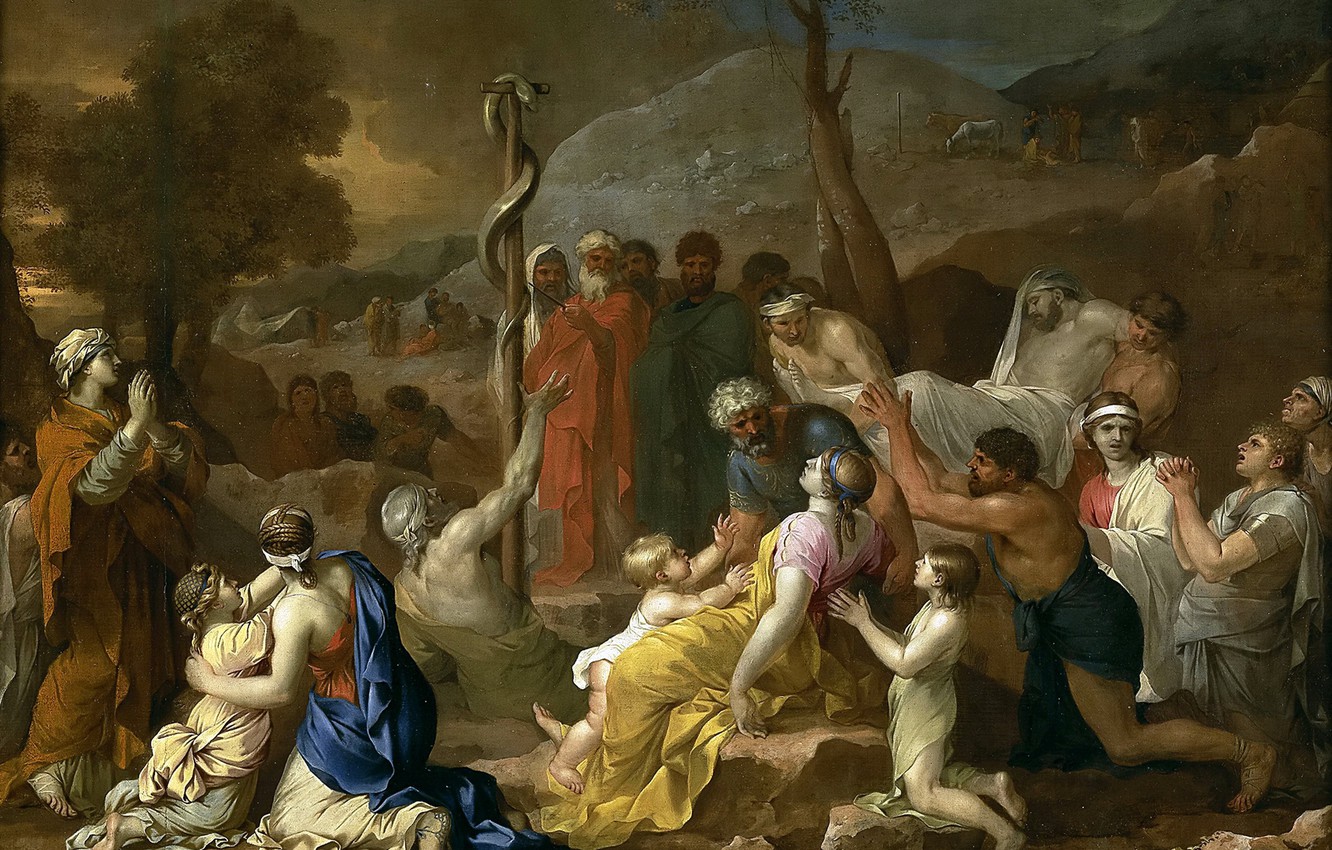
Moses and the Brazen Serpent - Sebastien Bourbon c. 1653-4
By John Fisher (assisted by AI)
From its opening chapters to its prophetic promises, the Old Testament consistently bears witness of Jesus Christ. While His mortal ministry is recorded in the New Testament, the foundation of His mission, identity, and redeeming power is woven throughout the earlier scriptures. As the Savior Himself declared, “Search the scriptures; for in them ye think ye have eternal life: and they are they which testify of me” (John 5:39). One fruitful way to find spiritual nourishment in the Old Testament is to look for symbols, types, and narratives that point to Christ—the true Bread of Life (John 6:48). These accounts not only prepare the way for His coming but also deepen our understanding of who He is and what He offers to all who follow Him.
Types and Symbols of Jesus Christ in the Old Testament
Manna: The Bread of Life
When the children of Israel wandered in the wilderness, the Lord provided manna from heaven to sustain them daily. The Lord declared, “Behold, I will rain bread from heaven for you” (Exodus 16:4). Each morning the people gathered this miraculous food, described as “a small round thing…like coriander seed” (Exodus 16:14–15), sufficient for their immediate needs.
Jesus later revealed the deeper meaning of this provision: “I am the bread of life: he that cometh to me shall never hunger” (John 6:35). Just as manna sustained Israel physically, Christ sustains us spiritually. The daily gathering of manna teaches dependence upon God and reminds us that enduring spiritual life comes only through continual reliance on the Savior.
The Sacrificial Lamb
At the time of the Passover, Israel was commanded to select “a lamb without blemish” (Exodus 12:5) and to apply its blood as a sign of deliverance. This act preserved them from death and marked their liberation from bondage.
John the Baptist later identified Jesus as the fulfillment of this symbol: “Behold the Lamb of God, which taketh away the sin of the world” (John 1:29). The Passover lamb prefigures Christ’s perfect, sinless sacrifice. Through His atoning blood, all who follow Him are delivered from spiritual death and freed from the bondage of sin.
The Brass Serpent
When Israel murmured in the wilderness, fiery serpents afflicted the people. The Lord instructed Moses to raise a brass serpent so that “every one that is bitten, when he looketh upon it, shall live” (Numbers 21:8). Healing came not through human effort, but through faithful obedience and trust in God’s appointed means.
Jesus explained the symbolism plainly: “As Moses lifted up the serpent in the wilderness, even so must the Son of man be lifted up” (John 3:14). This account teaches that salvation comes by looking to Christ with faith. His crucifixion, like the raised serpent, offers healing and life to all who turn to Him.
Jonah: Death and Resurrection
Jonah’s experience in the depths of the sea—spending “three days and three nights in the whale’s belly” (Jonah 1:17)—became a powerful sign of Christ’s future resurrection. Jesus Himself declared, “As Jonas was three days and three nights in the whale’s belly; so shall the Son of man be three days and three nights in the heart of the earth” (Matthew 12:40).
Jonah’s deliverance foreshadows Christ’s triumph over death. This parallel testifies that Jesus is the promised Redeemer who would conquer the grave and offer resurrection to all mankind.
What These Examples Teach about Jesus Christ
Together, these Old Testament witnesses teach that Jesus Christ is our sustainer, redeemer, healer, and conqueror of death. They show that God’s plan of salvation was established from the beginning and consistently revealed through inspired symbols and prophetic events. Beyond these examples, many readers are familiar with additional references—such as the messianic prophecies of Isaiah, the promised Seed of Abraham, and the righteous King foretold by the prophets—all pointing forward to Christ.
Living the Invitation to Seek Christ
In his message “Jesus Christ Is the Treasure,” Elder Dale G. Renlund encouraged us to “remember and always focus on Jesus Christ.” Studying the Old Testament with this purpose in mind transforms scripture reading from a historical exercise into a deeply personal act of discipleship. As we seek Christ in ancient texts, we become more attuned to recognizing His hand in our own lives—guiding, sustaining, and redeeming us today.
Conclusion
The Old Testament is far more than a record of ancient Israel; it is a powerful testimony of Jesus Christ. Through symbols such as manna, the sacrificial lamb, the brass serpent, and the experience of Jonah, the scriptures consistently point to the Savior’s mission and divine identity. As we study with intent to find Him, we are nourished spiritually and drawn closer to the living Christ. By remembering and focusing on Him—in scripture and in daily life—we discover that He truly is the greatest treasure.